BLOG about IBM Rhapsody. Contains technical information as well as more private travel stories.

Tag: UML (Page 3 of 3)

Stuttgart

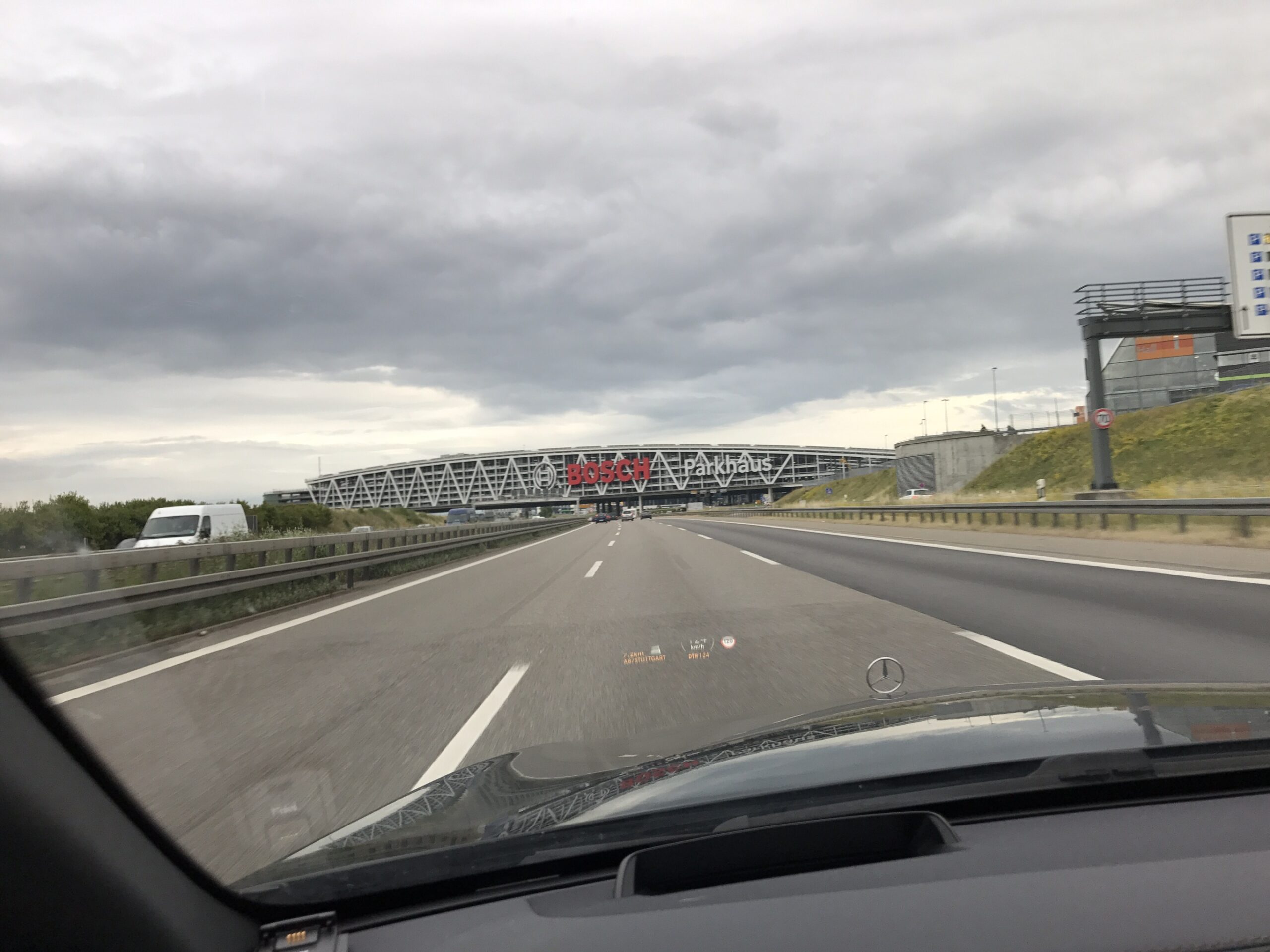
I do a lot of traveling. A whole lot of traveling. Mostly Germany but sometimes outside or way outside. But the city I travel to most is Stuttgart. Not because my car was made there but because we have lots and lots of customers here.

Stuttgart and the surrounding cities are not bad, just the traffic is really murdering. They even beat Munich in traffic jams. Part of it is caused by the geography, Stuttgart is a hole between some hills, there is no way you can build decent roads, what is there must be used, no room for more roads.

The other cause is the so-called “Stuttgart 21” plan. This involves railway only but it will take the complete main station and move it underground. If you look where the station used to be it looks like a nuclear bomb just went of…. Big hole with lots of machines. This has its influences on railway traffic but also on everything that goes through the city.

This week is Rhapsody Training at a customer. 5 days! A long time ago a 5 day Rhapsody Training was normal, unfortunately this is no longer the case. It went to 3 days, often only 2 days and there are companions that estimate their employers to be able to learn UML and Rhapsody in 1 day.

This is, of course, total rubbish. Learning UML and Rhapsody takes just as long as learning ‘C’ and compiler/debugger. If by now you think: “Learning ‘C’ goes quick” then please dig your memory for the truth…,. Before you are an experienced ‘C’ programmer, years go by!

The UML is not more difficult or easy to learn, it is just different. And… you have to know ‘C’’ (or ‘C++’) before. This is what Rhapsody generates.

What is difficult about UML/Modeling? Well.. the way you do it is very different from traditional source code programming. I think that is the most difficult part for most “converted programmers”. Modeling is an art, you learn it by doing a real good training (like ours… 😉 ) and by doing it! You need to practice, read a lot, try a lot.

I see many people using Rhapsody The way they use their IDE, try until the code generator produces the desired output. This is wrong! Follow the paths that people like Bruce Powel Douglas and others have described in books, modeling is a lot of work. In the end you will save because the number of errors and changes will be way lower than with traditional programming.

It pays off to invest in a good process (which diagram should I use when?, what information is where?)  and in making your model so that it is actually your documentation. Modeling takes time but it is time you have to take anyway to give your brain the time to understand what you are doing.

I always say: a model behaves just like your car. If your car is dirty, it does not drive “good”. As soon as you wash and vacuum it, you will sense that it drives “better”. Subconsciously, admitted but true. A model behaves the same. If you make it nicer, with straight lines and with elements that have the same size and are outlined you will notice that it makes more fun to use the model. Some think that the drawing part is wasted time: trust me, it’s not!

So beautify your model, insert navigation information so that other can also find their way in your model, use enough diagrams, (every diagram should answer a question) use requirements that you connect to model elements to show traceability. Use stereotypes, profiles and tags to store information in your model. After a while you will do that automatically and the quality of your modeling will increase dramatically. Also re-use will be much easier than it was.

Happy modeling with Rhapsody

Walter van der Heiden (wvdheiden@willert.de)

Marquardt – Rhapsody unlocks doors

Introduction

The software development division of the Marquardt company decided in 2012 to switch from structured programming using ANSI-C to a model driven development approach using UML including automatic code generation. The reason was to have a better position in the future to master the increasing complexity and requirements in the automotive supplier market easily.

THE PROJECT

The first project where MDD was used was the development of a wireless keyless-entry/keyless-go system for a well known German car manufacturer. The hardware platform was a 16 bit controller with 64 Kb ROM and 4 Kb RAM. The application to be developed had to cope with limitations as the very small footprint, the minimal processing power and still require very little resources at startup time.

These challenges provided the Marquardt Software Design team with at the trigger- after successful proof of concept – to do a future oriented switch and become an ‘Early Adopter’ in Model Driven Development (MDD).

AT THE START

The assumption that MDD could be of great use in software development was initially quite controversial in the software development team. Also the question if the keyless system would be a suitable candidate for a pilot project was doubted, especially due to its stringent resource requirements and the short time to develop. However, in the end it became clear that the
traditional methods of structured programming could no longer be used for such high requirements and time constraints in future projects. And although this keyless system project was not an ideal candidate as pilot project, given the short Time-to-Market that is common in the Automotive market, Marquardt decided not to wait with their switch to MDD. Its customers would benefit enormous of the innovative approach. The risks were carefully calculated and Willert Software Tools GmbH offered Training and Coaching during the entire product development process and helped in the Switch and the changed process.

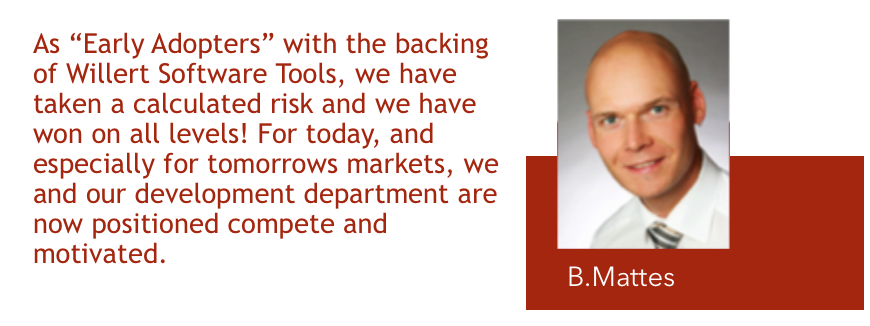
Inlay Bennie Mattes

DURING THE PROJECT

The project was carefully planned as pilot project to recognise the advantages of MDD during development. An investigation of tools to use was carried out, based on the requirements with respect to memory- and CPU resource usage and realtime behaviour, to determine how feasible the introduction of MDD would be with respect to memory usage, performance and real-time requirements.

The positive outcome of this investigation was convincing. The idea that restrictions due to software development in ANSI-C could be surpassed, was clearly valid. The development team of the pilot project defined the following goals:

The Tools: UML as modelling language, modelling in IBM Rhapsody in C extended with the Realtime eXecution Framework (RXF) by Willert Software Tools (see infobox) made it possible to meet the specific technical requirements and use code generation for the limited memory- and CPU resources.

  1. Realistic project conditions: It should be possible to realise the project without extra time or manpower. The use of trainer and coach from Willert Software Tools helped to meet these conditions.
  2. Focus Quality Management: The effects of the use of MDD should be measurable and reproducible. The first project phase included training and coaching which assured a successful start and use of the tools. Next, well-defined training and coaching during development were the base for reaching planned schedule in time and costs plus quality and support the motivation within development team. The success of the first development proved the approach and selected tools to be the right choice.
  3. During the project the restrictions with respect to footprint and CPU resources formed the technical boundaries. The methods and know-how of modelling were extended within the development team which helped greatly. In close cooperation with the Willert trainers and coaches and multiple workshops, even in close to final project phases, further optimisation in model and RXF were realised. In this pilot project all requirements regarding memory- and CPU resource usage and realtime behaviour were met.
  4. In parallel the testing was tuned: unit tests, software in the loop and software integration were adapted to the modelling process and even automated. This was an extra effect which was not accounted for at forehand.

THE GAIN

First and most of all: a successful project and satisfied customer. At a functional level the project had realised what probably also could have been realised in the originally used development methods. But using MDD the road into the future with increasing demanding requirements is now open. Moreover, the quality aspect of the software engineering shows improved ease of maintenance, modifications and robustness. Apart from the functional result of this

pilot project, Marquardt now is capable of meeting steep requirements and specifically in reacting flexible on changes in requirements desired by the customer during the project. In addition, the steps needed in changing the development process and tasks within the team were mastered successfully. These changes were supported by the Willert trainer and coach. This resulted in a highly motivated team and guaranteed progress even in difficult times.

Most importantly is that the new know-how within the team and the investments in the new tools offer Marquardt a highly efficient and motivated team, ready for the future. This switch used by Marquardt in this project was acknowledged as an improvement of the software development.

THE FUTURE

Future projects will use the investments of this pilot project being the software tools, not-productive man-hours and consultancy, needed to introduce the new technology.

Traceability and maintenance of existing applications is much easier at the model level. The development process and applications therefore have become more defined and predictable. This will in its turn have positive impact on quality and time plus costs.

For the team members of the development team the switch to MDD means increasing competence and knowledge of modern software engineering.

The successful pilot project confirmed positively the decision taken to start using a new development environment and helped the customer in its success-story. This project proved Marquardt being an innovative company having a competent software development team which can cope with the ever-increasing demands of the automotive industry, ready for the future.

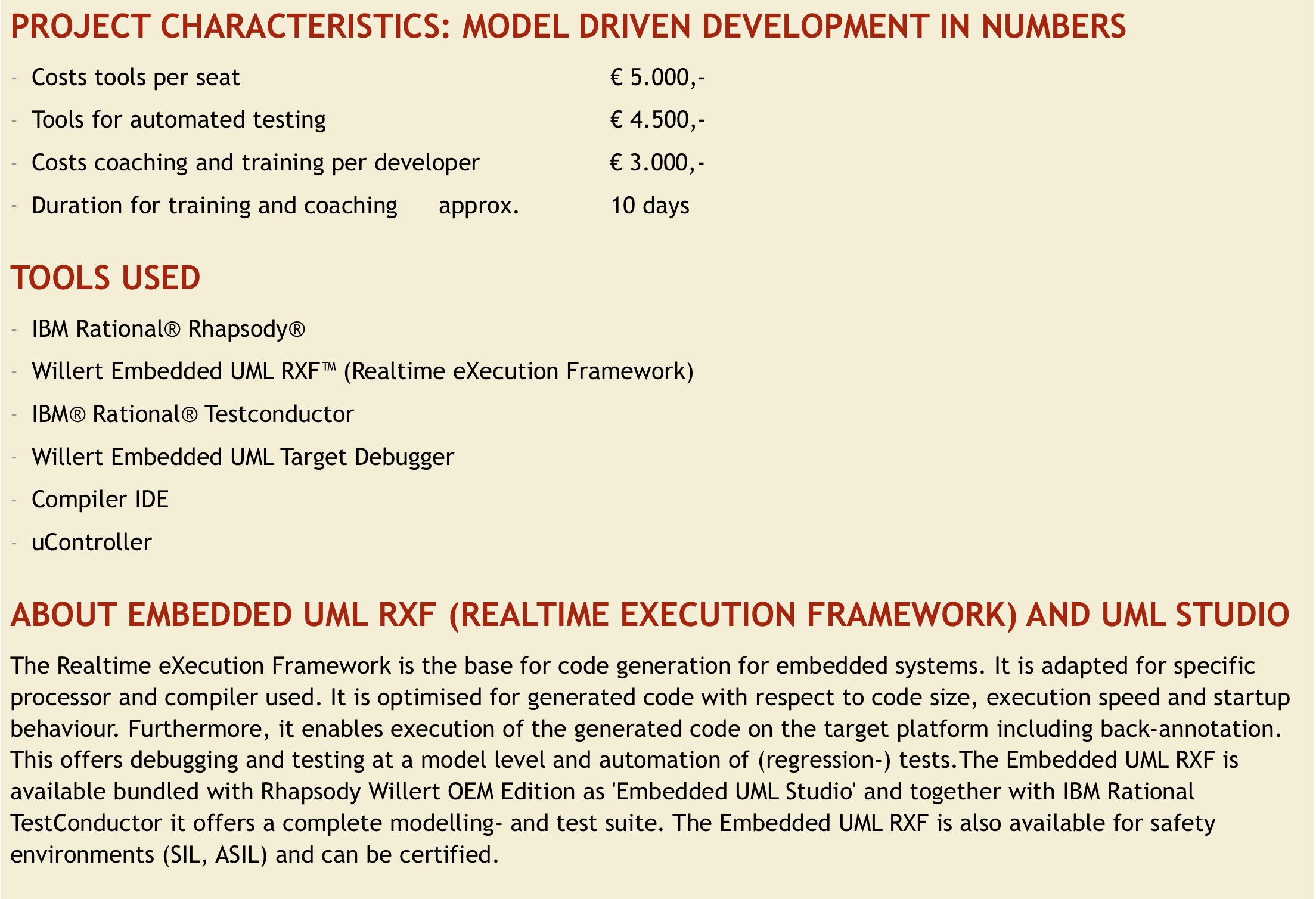
Inlay Marquardt Project

ABOUT MARQUARDT

Marquardt is an independent international and successful family owned company and leading manufacturer of electro-mechanic and electronic switches and -systems. Marquardt products are widely used by multiple car manufacturers. Marquardt also manufactures devices used in houses or for industrial appliances and is worldwide market leader in these areas.
http://www.marquardt.com

ABOUT WILLERT SOFTWARE TOOLS

The Willert Software Tools company specialises since 1992 in tools for Software Engineering with respect to realtime embedded systems. Willert has set its goal to offer technologies to enable customers to successfully develop software and support them in adapting the required tools. For this, Willert offers methods and tools plus training and coaching based on thorough knowledge of realtime embedded systems. Its customers include the automotive industry, aerospace, medical devices, public transport manufacturers, telecommunications, energy and infrastructural environment. Willert Software Tools has helped with numerous product specification, -development and Quality Assurance, for example vehicle control devices, coffee machines, frequency inverters, satellites, hearing instruments, door controls, fire alarms, röntgen devices, positioning systems and robotics.

Newer posts »

© 2026 Rhapsody TechBlog

Theme by Anders NorenUp ↑