Introduction
OK… today a little less Rhapsody Tech stuff and a little more about the rest of my life. Should be OK on a day full of snow….
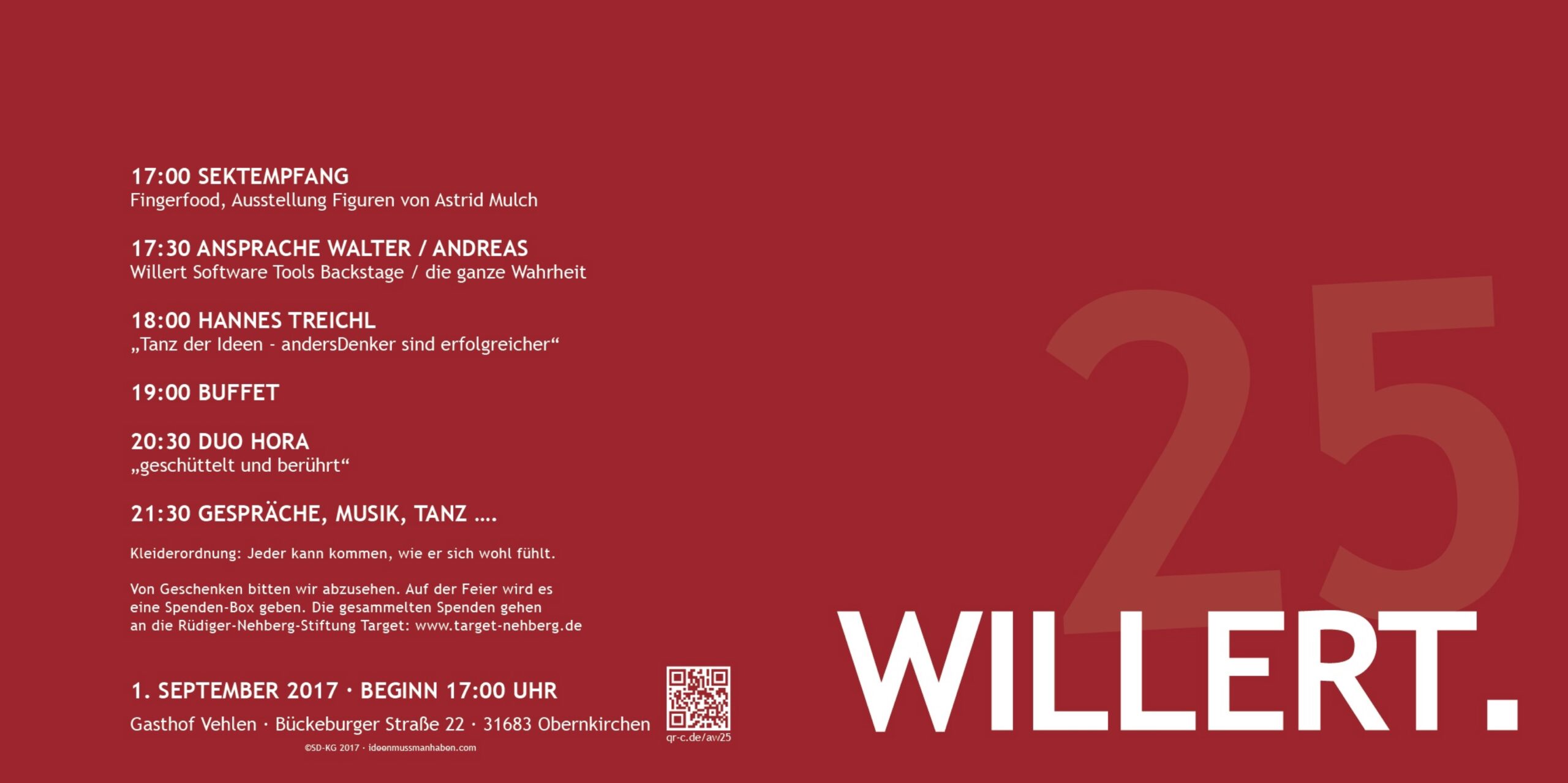
So my company is actually older than Rhapsody… On september 1 we celebrated our 25 years existence with a big party. But… 25 years… what happened in this time?
History
In 1992 Andreas Willert founded Willert Software Tools. His business idea was to sell tools that were there to create software for a specific microcontroller, at that time the Siemens C166.
This sounds like a crazy idea now in 2017 but in 1992, the world looked very different. Try to imagine the world back then….
There were only 8 and 16-Bit Micro-controllers, a few 32-Bit systems were there but they would cost a fortune. Even the PC’s were small 32-Bit systems, an Intel 80386 on 33MHz was not a bad system in that time.
The development tools in those days were all DOS based, Windows 3.0 was there but not really used. Development tools were also very loosely connected, mostly via vague intermediate formats. Some tools had separate compilers, linkers, locators, debuggers and assemblers.
Andreas had much knowledge about that. he had been working for Hewlett Packard, selling Logic Analyzers and for Tasking who sold compilers.
Tasking is like a common thread through the history of Willert. Many of the people who are involved have something to do or have a history with Tasking. I have worked there from 1995-2001. Andreas and I have met on a Tasking event (Actually an EmWare event, a company that was active with IoT, 15 years too soon…) in Salt Lake City.
The choice for the Siemens C166 Micro-controller was a good one, with the 1992 knowledge. But the Infineon spin-off, the flash disaster and the lack of a good successor the C167 were things that were not good for business. Also development tools improved and there was not much need for an expert in connecting debuggers, emulators and compilers.
Andreas was always looking for new business opportunities and landed soon in the Modeling area with Telelogic SDL. Also EmWare’s EMIT that was being sold by Tasking as Master Distributor was in his interest. This is where Andreas and I met and started to do things together. In 2000 we held our first tour through Germany to try and find customers for the EMIT product. We were way too early (also a bit of a common thread in our lives)
In 2001 Tasking was taken over by Protel and was renamed to Altium. I was kicked out pretty soon, together with other people and I called Andreas to tell him that. We decided to meet and discuss what we could do together. Since that I am the co-owner of Willert Software Tools.
So from that on we could concentrate more on technical stuff. The rise of the use of modeling tools was a new opportunity to sell products because we had knowledge that would encourage customers to choose us as supplier. We became the distributor of a fresh German subsidiary of an American company: I-Logix. they had a UML Tool called Rhapsody, we obtained the rights to sell that, restricted to certain markets since there was another company selling that.
2001 was not really the best year to begin a business… There was already the internet crisis but after September 11 the phone stopped ringing and we had to fire people to survive. Slowly we fought our way back and re-hired most of the staff.
In the meantime i had created the first version of our framework, at that time it was just the “standard” OXF with the correct adaptation to run with CMX-RTX and, of course, the Tasking compiler. We called the product “Bridge” since it formed a bridge between all different tools.
The first Bridge should have been a ‘C++’ Bridge, for Tasking and CMX-RTX. After a few weeks of fighting (learning Rhapsody, understanding how to make an adapter, learning what an RTOS was, learning ‘C++’…) i figured out that adapting the OXF to Tasking was impossible. At that time it was not a ‘C++’ compiler but some front-end that would translate ‘C++’ into unreadable ‘C’. Luckily, the customer that ordered the adapter agreed on using Rhapsody in ‘C’.
Soon we received requests for other “bridges” for other RTOSes and compilers. The first Bridge was baptized “WST1” and we started working on WST2, ‘C’, C167, CMX-RTX and Keil. Reinhard Keil himself helped us to get this running and it was done a lot faster then WST1.
Just do it
After a while, frantically trying to create a market for UML Tools, we decided that the tool was overpriced. It was, perhaps, a good price for a UML Tool in the “IT-world” but it was priced 3-4 times as much as an average compiler. Andreas and I created a presentation that we held against the CEO of I-Logix, Gene Robinson who was visiting Germany. We suggested that we need a special version for embedded with a special (lower) price. His legendary words were: “Just do it”.
Gene Robinson passed away in june 2016. He was a great guy and we miss him very, very much.
A year later a customer asked for a Bridge without an RTOS. At that time Mark Richardson from I-Logix had created a Rhapsody model with a stripped Framework. I took that and created the first “lite” Framework. WST2lt was born. Although we thought that would be a “one-off” it turned out to be the #1 sold framework.
Versions and versions followed. The WSTxx names went and in Version 5 the Composers were introduced. Clemens Maas, our Development Manager at that time, loved classical music and took composer names to name the different Bridges. Beethoven, Mozart, Bach but also names with Easter Eggs like Sibelius (Finnish composer for the Linux Bridge) Wagner and Schneider (Customer names)
Telelogic
Then in 2006 I-Logix was bought by Telelogic. Quite a shock for us and for Telelogic. Business was shook up and we were not doing that well for quite a while. Telelogic was not used to having distributors and it was a small miracle that they kept us. Pro was that we also started to learn Doors which helped us survive the “Modeling Winter”.
After 2 years we were just about to get used to Telelogic and then the next take-over was announced….
IBM
Yes. IBM took over Telelogic and we started over again. This was a hard time for us, the IBM processes were very different and sometime pretty hard to understand and to implement in our own company. But we managed and are successful in selling IBM products and selling our own products.
We are now with 20 people and active in Requirements Engineering, Model Based Systems and Software Engineering, we have our own tools like the RXF, the embedded UML target debugger, the Requirements eXChanger, we are working on a very good Automotive/AUTOSAR Toolkit.
“In & Out” in 1992
Mobile phones were there but only for the rich and famous. Definitely no smart phones. Internet was just about to start but nowhere near to what it is now.
We had DOS and Windows 3.0, Windows 3.1 was released that year.
The war in former Yugoslavia started.
We had our own currencies, Deutsch Mark, Franc, Gulden etc.
The Olympic Winter and Summer Games were held in the same year every 4 years (in 1994 they would be alternated every 2 years starting in Lillehammer in Norway)
Czechoslovakia is split up in the Czech Republic and Slovakia.
in that year was the “Freddy Mercury Tribute Concert”.
El-Al flight 1862 crashes in Amsterdam.
Denmark became the European champion Soccer (“The Beach Team” because the players were called back from holiday since Denmark was called to replace Yugoslavia that was banned because of the war)
The Maastricht Treaty is signed, founding the European Union.
Presidents and world leaders then were George Bush (Senior!), Boris Yeltsin, John Major, Helmuth Kohl. Bill Clinton was elected as the new President of the USA.
Happy modeling with Rhapsody
Walter van der Heiden (wvdheiden@willert.de)